Article
Why Customer Obsession Isn’t Enough
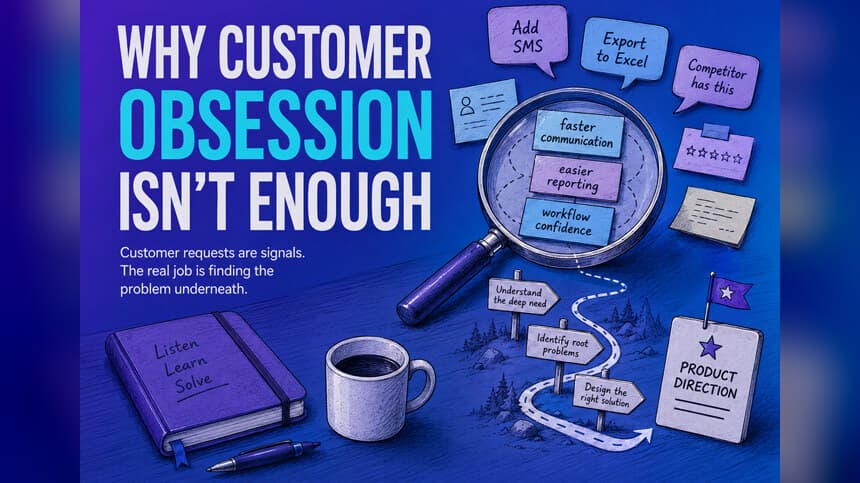
Customer requests are signals. The real job is finding the problem underneath.
Customer obsession sounds like an unquestionable good.
And in many ways, it is.
You should care deeply about your customers. You should listen to them. You should understand their frustrations, study their workflows, read their support tickets, watch where they struggle, and take their feedback seriously.
But here is the part that often gets missed:
Listening to customers is not the same thing as understanding the problem.
And when teams forget that distinction, customer obsession can quietly turn into feature obsession.
Every request is already a solution
A customer asks for an “Export to Excel” button.
Another asks for SMS reminders.
Another says your competitor has a dashboard you do not have.
Another sends a support ticket explaining which Stripe API endpoint they think you should use.
On the surface, this all looks like useful feedback. And sometimes it is. But every one of those requests is already a proposed solution. The real work is figuring out what problem is hiding underneath it.
Why do they need the export?
What is breaking down without SMS?
What job is that competitor’s dashboard helping them do?
What experience led them all the way to researching API endpoints?
Customers are experts in their pain
Customers are experts in their pain. They are not always experts in your product strategy.
That is not a criticism of customers. It is the whole reason product management exists.
A customer can tell you where something hurts. They can describe the workaround, the frustration, the spreadsheet, the missed payment, the angry parent, the extra hour at the end of the day.
But only the product team can step back and ask:
Does this fit the vision of the product we are trying to build?
When the tail wags the dog
That question matters.
Because without it, the tail starts wagging the dog.
The roadmap becomes a collection of customer requests. The loudest accounts get the most influence. The product becomes harder to explain. The user experience gets more complicated. The team feels busy, responsive, and customer-obsessed, while slowly drifting into feature factory mode.
The strange part is that none of this feels irresponsible in the moment.
Quite the opposite.
It feels helpful.
It feels fast.
It feels customer-centric.
Caring enough to say no
But being customer-centric does not mean building whatever customers ask for. It means caring enough to understand what they actually need.
Sometimes the right answer is to build the feature.
Sometimes the right answer is to build a different feature.
Sometimes the right answer is better education, better onboarding, better defaults, better wording, or a workflow change.
And sometimes the right answer is no.
That is the uncomfortable part of customer obsession. If you are truly trying to serve customers, you cannot only serve the request in front of you. You have to serve the product they are trusting you to protect.
A vision-led product does not ignore customer feedback. It takes customer feedback seriously enough to interrogate it.
Obsess over problems, not requests
That is where problem-first thinking becomes essential.
Before asking, “How quickly can we build this?” the better question is:
What problem would this actually solve, and is it the right problem for us to solve?
That one pause can be the difference between a product with a point of view and a product that slowly becomes a pile of exceptions.
Customer obsession is a great starting point.
But it is not enough.
The real goal is not to be obsessed with customer requests.
The real goal is to be obsessed with customer problems.
And that difference changes everything.