The Problem-First Method
Stop building solutions in search of a problem. A practical framework to help you recognize when you've drifted from the problem—and find your way back before it's too late.
- Feature Alignment Document (FAD) template
- 10-Question Problem Validation Checklist
- Five Whys Worksheet
- Problem Atlas (Problem-Driven Roadmap)
What you'll learn
Frame the right problem
Stop anchoring on solutions. Use first principles, 5 Whys, and evidence to isolate the real job to be done.
Tools that force honesty
Use the Feature Alignment Document (FAD) and 10-Question Checklist to make “linger on the problem” something you can actually do.
Real stories, real lessons
Study stories—some painful, some amusing—of products that solved the wrong thing, and those that got it right.
Who it's for
→You ship features that get built, launched, and quietly ignored—and you're tired of pretending that's normal.
→You want a way to say "no" to requests that sounds less like gut feeling and more like evidence.
→Your investors asked you to "add AI" and you're pretty sure they don't know what problem that solves either.
→You're looking for a framework that doesn't just sound good in theory but actually changes how your team talks about what to build next.
→You've sat through one too many roadmap meetings where "because competitors have it" was the entire justification.
→You want to stop confusing activity with progress—and you need something more concrete than "just talk to users."
Inside the book
Part I: The Trap
- 01The Autopay Mistake — When "competitor has it" becomes your North Star
- 02Invented Problems — Juicero, Safe Oasis, and the compliance mirage
- 03Solutions in Search of a Problem — Google Glass and the answer nobody asked for
- 04The API Mirage — When discovery gets skipped
- 05Why We Love Solutions — The dopamine trap (ft. Air Canada's chatbot disaster)
- 06The Three Disguises — How solutions sneak past careful teams
- 07The Default Setting — Why solution-first thinking feels like gravity
Part II: The Mindset
- 081,000 Songs in Your Pocket — When Apple got it right
- 09Questioning the Water You're Swimming In — Spotify and first-principles thinking
- 10Ninjas and Fireworks — Teletherapy in a pandemic
- 11The Parking Lot Problem — Multiple stakeholders, competing truths
- 12The Spreadsheet I Didn't Build — Solving the real problem
Part III: The Framework
- 13The Feature Alignment Document — Not another PRD
- 14The 10-Question Problem Validation Checklist — Pre-flight checks before you build
- 15Problem Atlas — The problem-driven roadmap
- 16Five Whys — Or: Why your first answer is usually wrong
- 17Getting to the Problem — Solution or problem? The game
Part IV: Building with Discipline
- 18The SMS Project — Where theory met practice
- 19Different Customers, Different Problems — The local optimum trap
- 20Sometimes You Need to Say No — Complexity is the silent killer
- 21The Discount Code We Didn't Build — Resisting the obvious
- 22Tough Problems — The ledger that wouldn't balance
- 23Reading Between the Lines — Playing detective with support messages
Plus: Your Toolkit
- →Feature Alignment Document (FAD) template
- →10-Question Problem Validation Checklist
- →Five Whys Worksheet
- →Problem Atlas Template
Free Sample
Read the Introduction and Chapter 1 (The Autopay Mistake)
Download Sample (PDF)Listen to the audiobook
Press play to hear a free preview, narrated by Jeffrey Holz.
From the reviews
Independent reviews of The Problem-First Method.
“Dias writes with humor, humility, and sharp observation.
One minute he is discussing feature parity traps, and the next he is comparing customer tech stacks to a collapsing Jenga tower. The tone stays conversational without losing depth.”
“But the real value of The Problem-First Method is not productivity. It is perspective.
This book forces you to confront how often modern work rewards motion over understanding. How often teams celebrate shipping instead of solving. How often businesses confuse customer requests with customer pain.”
“The Problem-First Method is one of those rare product books that actually feels written by someone who has sat through the chaos of building software in real life. Not the polished LinkedIn version of startup life. The actual version.”
“Probably one of the most useful books a product builder could read right now.”
“Clear, engaging, and refreshingly self-aware, this book reminds us that great solutions begin with great questions.”
“The writing feels like sitting across from a seasoned product builder over coffee.”
“By the final pages, I wasn’t just thinking about product management. I was thinking about decision-making in general.”
“I found The Problem-First Method to be
an insightful and highly practical business book that cuts through much of the noise surrounding product development.”
“One of the strongest aspects of this book is its focus on actionable processes rather than abstract concepts.”
“The book offers a balanced mix of storytelling and actionable frameworks, making it useful for both experienced product managers and first-time entrepreneurs.”
“It’s an excellent addition to the bookshelf of any entrepreneur or product professional who wants to build smarter rather than simply build faster.”
 (opens in a new tab)
“Sometimes, that pause is
the difference between building something that matters and building something nobody asked for.”
“This entire manual is
written in a charming, disarming, and personable style
and shines a spotlight on the growing frustration with quality assurance and service in general.”
“In the present age of APIs, algorithms, and artificial intelligence, the concepts of this framework prove to be modern common sense that elevates every aspect of doing business.”

“Dias avoids excessive jargon and
writes with the clarity of someone sharing hard-earned lessons rather than delivering lectures.”
“By encouraging readers to slow down, ask better questions, and validate assumptions before pursuing solutions, Kevin Dias provides
a framework that is both practical and widely applicable.”
“Insightful, honest, and grounded in real experience
, The Problem-First Method offers a valuable reminder that successful innovation rarely begins with an answer.”
“The Problem-First Method by Kevin Dias is
a sharp, funny, and unusually honest product-building book
that turns its author’s own costly mistakes into a genuinely useful discipline.”
“The writing is crisp and funny, the structure is purposeful, the frameworks are practical
, and the through-line — slow down, stay with the problem longer than feels comfortable, and measure success by what your customers can finally stop worrying about — is delivered by someone who has paid for the lesson in real shipped failures.”
“For founders, PMs, designers, and engineers tired of shipping features that get launched and quietly ignored,
this is close to essential.”
“This was
an insightful and engaging non-fiction read
for any business or data-driven readers out there.”
“Rather than feel like a lecture from a tech guru,
the book feels more like a conversation between two people
, as one relays their experiences and the lessons they’ve gleaned over a cup of coffee.”
“Engaging, memorable, and expertly written, author Kevin Dias’s ‘The Problem-First Method’ is
a must-read non-fiction business and tech book that readers will not be able to put down.”
 (opens in a new tab)
“Clear, precise, and well-structured.”
“Bridging theory with practice through storytelling.”
“It should serve first-time product developers and experienced builders equally well.”
“Particularly useful is a section on when to say no…
a counterintuitive but valuable piece of advice that sets this work apart from typical product development guides.”
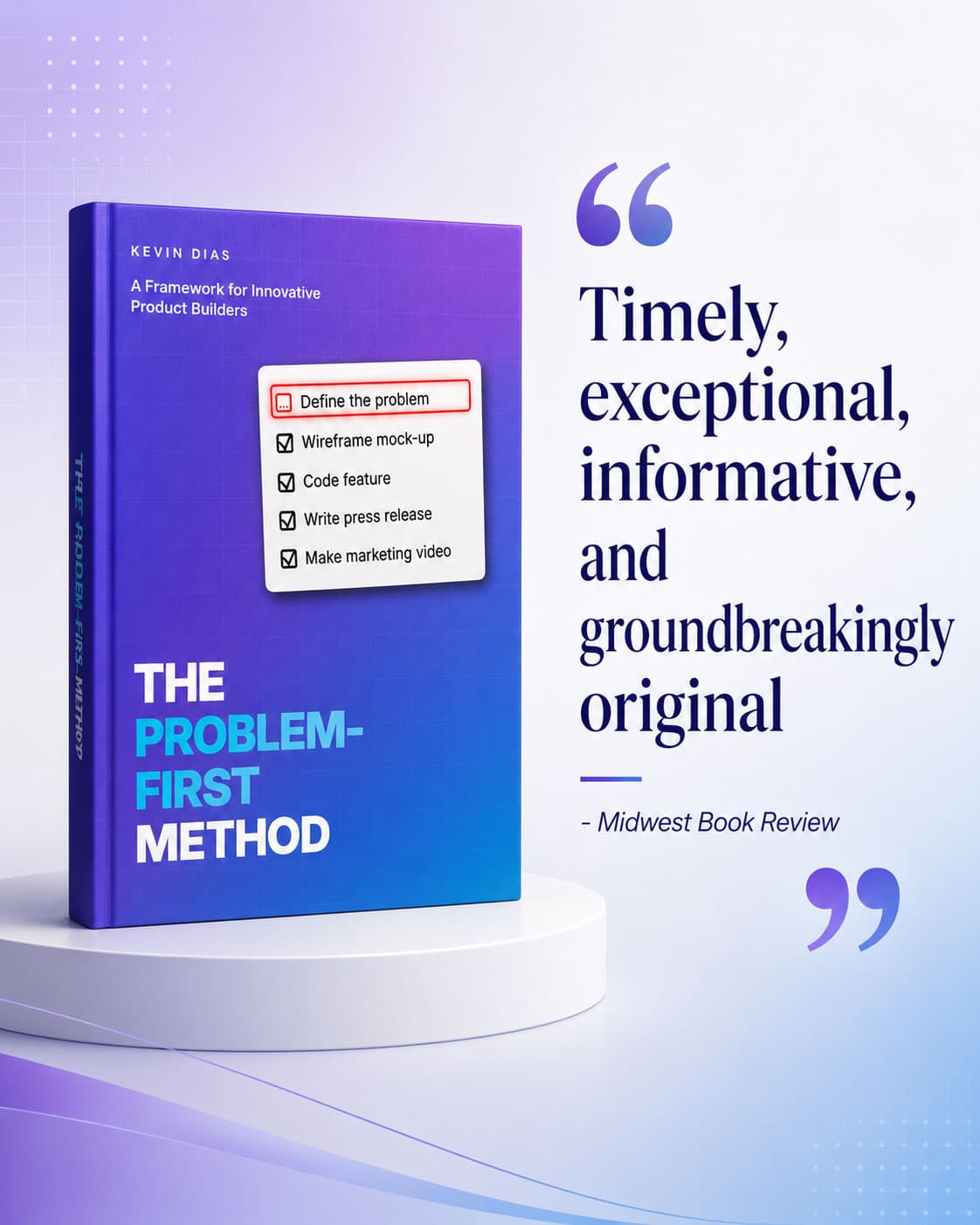
“Timely, exceptional, informative, and groundbreakingly original
, The Problem-First Method is exceptionally well written and impressively ‘reader/user’ friendly in organization and presentation.”
“Especially and unreservedly recommended
for personal, professional, community, and college/university library Business Management collections and supplemental MBA curriculum studies lists.”
“Kevin Scott Dias’s The Problem-First Method has
the plain good sense that I am looking for from a product development book
: he tells teams to prove the customer need before anyone falls in love with a feature.”
“Well written and insightful,
Dias’s book is the one I wish I’d had 10 years ago.
Thankfully, readers have it now. Very highly recommended.”
“The Problem-First Method is a gem of a book for any ambitious and creative product-building team.”
“Some of the topics are really technical, but Dias does a brilliant job of explaining the concepts in a way that is easy to follow and understand.
It’s an informative and illuminating guide that I will heartily recommend to all product builders.”
“The Problem-First Method lays out
a straightforward way to spot real problems and figure out how to tackle them.
It pushes you to start with the problem itself, rather than rushing to fixes, and shows you how to ask better questions.”
“This book forces you to rethink those usual production habits
and helps you grasp what your customers actually need.”
“This is a vital read
with good tips and tools that can be used by startups and companies that wish to find real customer and user problems.”
“This book focuses on creating solutions that actually make a difference, cutting out the busywork, and building products people want enough to buy.”
“I particularly appreciated his observation that
real problems are often quiet while competitor features are loud
, a simple distinction that immediately reframes how you listen to customers.”
“The Problem-First Method is
the kind of book you keep open on your desk, not just read once and shelve.”
“The writing stays lean and scene-driven, never drowning in consultant-speak.”
“Then the wins land: ninja fireworks keeping four-year-olds on teletherapy calls,
billing cut from two weeks to two minutes after asking Nicole one better question
, and practical tools like Feature Alignment Documents for teams staring down Friday’s sprint review.”
“Dias won’t hand you a miracle framework.
He’ll make you harder to fool when sales is waiting.”
“Teaches how to spot real problems and save time.”
“5 out of 5 stars.”
“This is a book that upcoming builders and businesspersons would find really helpful.”
“It gives real examples through experience, which makes it so relatable.”
“A sharp and useful book for product managers, founders, and anyone who decides what gets built.”
“Dias has written something most product builders will recognize themselves in.”
“The practical tools are where the book earns its keep.”
“A valuable read for product managers.”
“A thorough guide.”
“Helpful tools to build products with discipline.”
“Seasoned perspective and credibility.”
“Illuminating business book.”

“Dias’ framework is
bracingly cleareyed and straightforward
, and his writing style makes it easy to understand and implement.”
“Dias keeps the chapters fast-paced, filled with examples … and bullet points to break down a very large amount of information into
clear, memorable prose that will be accessible even to non-specialists.”
“Test your critical assumptions before you set off on building a solution, he counsels, which is
advice with far more general applications.”
“A smart and companionable overview of problem-solving in the product-building field.”
“Dias presents a
comprehensive guide to product development.”
“The Problem-First Method is
a compelling business guide that encourages focusing on problems that matter.”
“The prose is straightforward and direct, making good use of accessible analogies.”
“Short sentences are staggered for dramatic effect, resulting in
an engaging rhythm
as the book outlines the tools that are needed to craft solutions to real problems.”
“A helpful business guide, The Problem-First Method is
filled with insights on creating products and services that customers want and will pay for.”
Readers’ verdict
Real words from people who actually read the book.
“Having spent almost 40 years in the B2B technology industry across both Sales and Customer Success leadership, I found The Problem-First Method to be one of those rare books that immediately resonates because it's grounded in reality rather than theory. Kevin Dias puts words to a problem I've witnessed firsthand dozens of times at multiple technology companies. Too often, product teams build features because they seem innovative or exciting, while sales teams enthusiastically sell the vision. The result is vaporware that never materializes, products that fail to gain adoption, or solutions that customers eventually abandon because they don't solve a meaningful business problem. I've lived through all of it—from selling features that never shipped to watching promising products churn at renewal because they failed to improve efficiency or deliver a measurable return on investment. Kevin makes a compelling case that sustainable product success comes from deeply understanding customer pain points and validating that a solution creates measurable business value before investing heavily in development. That philosophy aligns perfectly with what I've learned over three decades working directly with customers. The line in the book that resonated with me most was Kevin's wish that someone had written this book years ago. I couldn't agree more. I only wish it had been written 30 or 40 years ago. Had more product leaders, engineers, sales teams, and customer success organizations embraced these principles earlier, many of us—and our customers—would have been far more successful.”
“This book is very insightful, helpful, filled with new ideas, honest and thought provoking. I ordered 4 more books to give to friends.”
“I work in IT, not as a builder, and picked this up because the author's a friend. Turns out the method applies anywhere people bring you problems disguised as solutions. "The share is slow" is never about the share. "We need SMS reminders" is never about SMS. Half my job is refusing to act on the first sentence someone says and digging until I find what's actually broken upstream — and this book gives that instinct a name, a structure, and a few tools I'll actually use. Problem-first is something most teams know they should do and somehow never do. This book is a clear, honest guide to actually getting there.”
“Excellent book. Kevin's book really helps you to work through your business problems with various tools and stories and to help prevent you from drifting away from those problems. I highly recommend this book.”
Note: one of the perks of being an indie author with my own site is I get to do what I want — and that means showing my mom’s testimonial. Yes, it’s extremely biased. Yes, I’m still showing it.
Reviews on other sites
What readers are saying on Amazon, LinkedIn, and beyond.
The Executive Bookshelf: Critical Reviews of Today's Top Business Minds
Published on LinkedIn on September 10, 2026
As someone who has been in the trenches of product building, The Problem-First Method by Kevin Dias felt like a personal intervention. Dias delivers a brilliantly ego-free, practical guide that exposes the tech industry's biggest vice: falling in love with solutions before fully understanding the problem. Drawing from his real-world successes and transparent failures as the founder of Ambiki, he perfectly captures the dangerous "dopamine hit" teams get from rushing to ship features that customers ultimately ignore. It’s an essential reality check for any founder, product manager, or engineer who has ever built something perfectly, only to realize they built the wrong thing. What makes this book a must-read isn't just the diagnostic critique, it’s the actionable toolkit. Dias replaces bloated, corporate frameworks with lightweight, high-utility alternatives like the 90-second Feature Alignment Document (FAD) and the concept of a "Problem Atlas." The writing is sharp, relatable, and packed with concrete case studies (like the brilliant "Autopay Mistake") that illustrate exactly how to play product detective. If you are tired of building features in search of a problem and want to start shipping software that drives real, verified customer value, keep this book on your desk.
Good tool
Reviewed in the United States on July 27, 2026 · Hardcover
Hands on book that you can actually use. I liked the personal experiences that are shared. There were many helpful tips and tricks that can be used. Very realistic approaches.
Define the problem first, find a solution after
Reviewed in the United States on July 15, 2026 · Paperback
I truly believe that many people can find this book curious and helpful even if they are not in product development, the knowledge shared by the author is applicable not only to professional fields but to personal life too. I loved one of the main highlights - there is no need to rush with a solution you have for a problem before it is made sure what the core problem is. This read reminds to keep mind cool, slow down and always take time to observe and analyze situations better in order to make the best decisions.
The Antidote to Wasted Engineering Time
Reviewed in the United Kingdom on July 9, 2026 · Hardcover
As someone who has been in the trenches of product building, The Problem-First Method by Kevin Dias felt like a personal intervention. Dias delivers a brilliantly ego-free, practical guide that exposes the tech industry's biggest vice: falling in love with solutions before fully understanding the problem. Drawing from his real-world successes and transparent failures as the founder of Ambiki, he perfectly captures the dangerous "dopamine hit" teams get from rushing to ship features that customers ultimately ignore. It's an essential reality check for any founder, product manager, or engineer who has ever built something perfectly, only to realize they built the wrong thing. What makes this book a must-read isn't just the diagnostic critique, it's the actionable toolkit. Dias replaces bloated, corporate frameworks with lightweight, high-utility alternatives like the 90-second Feature Alignment Document (FAD) and the concept of a "Problem Atlas." The writing is sharp, relatable, and packed with concrete case studies (like the brilliant "Autopay Mistake") that illustrate exactly how to play product detective. If you are tired of building features in search of a problem and want to start shipping software that drives real, verified customer value, keep this book on your desk.
Slow Down to Solve
Reviewed in the United States on July 6, 2026 · Hardcover
I found The Problem-First Method from the author's blog. If you're on the fence of buying this book after reading the review, I highly recommend checking his blog out. Few books or ideas are truly novel, and this one is no exception. However, its core message is worth restating loudly, especially for those working in software development. The gist of the book is widely known but rarely practiced. It is increasingly falling by the wayside as building software becomes easier with the help of AI. Where this book shines is in the application. It's a clear handbook of how to slow down product development to ensure you're building the **right thing** for the **right problem**. With the later being the most important. Kevin starts out explaining the problem in product development with jumping straight to the solution. It's common for many of us to to jump from problem straight into a solution. And his argument is we need to slow down to better understand the problem entirely before attempting to solve it. Easy right? Mostly. But the wrench is when the problem and solution is presented to you by customer. Sometimes it's provided bluntly. Other times it's provided in a round about way as in why does your product not have a feature your competitor has. He does a tremendous job of explaining these circumstances along with stories from his professional life including mistakes his team and him have made. His writing is straight forward and approchable. He's not speaking down to the reader from his high horse as a tech executive but as someone who is in the trenches building a product loved by his customers and trying to do the right thing. Highly recommend reading this book if you're anywhere near product development at a software company. From customer support to sales to engineering, you'll get your money's worth. Suggest buying multiple copies for your colleagues to effect change and adjust bad patterns. I'd place this book right between some of my favorites for product development including The Mom's Test and Toyota Production System (the 5 Whys).
Analyzing problems properly before thinking of solution is just the skill we all need
Reviewed in the United States on June 25, 2026 · Paperback
PAPERBACK -The Problem-First Method by Kevin Scott is a perfect book for managers, entrepreneurs, businesspeople, and leaders to dig down into the real problem before the solution. He provides strategies, tools, and techniques. He also discusses real case studies to avoid struggle and the real cause of the problem. He guides against purposeless effort and provides guidance, deep understanding of the problem, and a path to get rid of it. He guides us to keep looking at the problem until it gets resolved. It warns against market trends and against following competitor practices. The organization should support teams focusing on resolving the problem, not just looking at it. The author prioritizes problems over everything else. The book is well written with a unique plot that keeps the reader captivated. It is for leaders to guide teams in their work.
A Practical Guide to Problem-First Thinking
Reviewed in the United States on June 22, 2026 · Paperback
"The Problem-First Method: A Framework for Innovative Product Builders" by Kevin Dias explains how builders can identify real problems instead of rushing into solutions. It clearly separates problem statements from solution statements using real examples such as Autopay by SimplePractice and Juicero, showing how customer requests can easily mislead teams into building the wrong thing. It introduces the Feature Alignment Document (FAD), a tool that helps builders confirm they are solving the right problem, while also addressing the pressure of competitors and distractions that can blur judgment. The book blends relatable experience with practical frameworks, making it easy to understand and apply, and it gradually moves from the trap, the mindset to structure and disciplined execution. I found it practical with no challenges or dislikes, and I recommend it to upcoming builders and business professionals who want to avoid building the wrong solutions entirely.
Interesting
Reviewed in the United States on June 21, 2026 · Paperback
Strong reflection on product-market fit. It clearly shows how copying competitor features can waste time if you don’t understand customer context. The lesson is sharp and practical: build for real workflows, not surface-level requests. Great reminder that speed means nothing if you’re solving the wrong problem.
Useful
Reviewed in the United States on June 13, 2026 · Paperback
I really enjoyed reading this book because it seems it was written by someone who has been through the ups and downs of building products, not someone trying to sound like a guru. The author is honest about mistakes, and that made the lessons much more real. I found this useful.
Insightful and Memorable...A Must-Read!
Reviewed in the United States on June 13, 2026 · Paperback
This was an insightful and engaging non-fiction read for any business or data-driven readers out there. The author finds a perfect balance between concise writing and a more personal tone, allowing them to reach the audience more quickly. Rather than feel like a lecture from a tech guru, the book feels more like a conversation between two people, as one relays their experiences and the lessons they've gleaned over a cup of coffee. I think this book will appeal to both tech-minded and non-tech-minded individuals for the personal lessons. The author is able to impart. So many times solutions present themselves that seem like the best option because they are either the most expensive or the most high-tech, but as this book teaches, sometimes those solutions can cause more problems down the line and are simply quick fixes for a problem that needs a real solution. All this book does is speak to a specific business-driven mindset; it is also a lesson in everyday life: slow down and see a problem through, rather than rely on quick solutions.
Very solution oriented
Reviewed in the United States on June 10, 2026 · Paperback
The Problem-First Method: A Framework for Innovative Product Builders by Kevin Scott Dias is a fantastic manual designed to help people solve problems quickly and effectively and not chase their own tails. Far too often we come across a problem and immediately try to solve it. Sounds totally fine, until that problem happens again, or it happens slightly differently, or in a different location. Solving the problem is not necessarily the answer because what is really important is solving why the problem is taking place. This book is a guide and a reminder to make sure you address the why, to take your time when coming up with solutions so you know you are taking the best steps, and to make sure you are using your time in the best way possible. The author uses many of his own examples from his time spent working with different companies in very specific fields, but the strategies can be applied to just about anything: schools, large businesses, auto-shops, you name it. The book is simple to use and solution oriented which is what we should all be when dealing with our own careers.
Highly Recommend
Reviewed in the United States on June 5, 2026 · Paperback
"The Problem-First Method" is a refreshing reminder that great products start with understanding problems, not building features. Using his experience creating Ambiki, Kevin Dias shares practical lessons on why even the most talented teams often invest in solutions nobody truly needs. Through honest stories, industry examples, and proven strategies, he shows how to make problem-first thinking a lifelong habit. I liked the book’s straightforward and realistic approach on decision-making and problem-solving and how relatable the examples are. Highly recommend for anyone determined to build meaningful products that last.
a practical and insightful approach
Reviewed in the United States on June 3, 2026 · Paperback
The Problem-First Method offers a practical and insightful approach to product development, emphasizing the importance of understanding problems before rushing to solutions. Drawing from real-world experiences, Kevin Scott Dias presents useful frameworks and relatable examples that highlight common pitfalls faced by founders, product managers, and innovators. Clear, engaging, and grounded in practice, this book provides valuable lessons for anyone looking to build products that truly meet customer needs.
Difference Between Real Problems and Imaginary ones
Reviewed in the United States on June 2, 2026 · Paperback
"The Problem-First Method: A Framework for Innovative product Builders" written by Kevin Scott Dias draws on his real world experience building Ambiki to make a convincing case for solving actual problems before jumping to solution. The hardest lesson is how to maintain discipline when customers hand you solution, sales want features by Friday and your ego whispers that of course you can build that. This book is highly recommended for founders and anyone tired of building things nobody actually need.
Working Towards Real Solutions
Reviewed in the United States on May 30, 2026 · Paperback
The book's message is simple. Take an effort to find the actual problem and then you can create a solution that adds value to your customers. The author is articulative and shares real-life incidents of how he or some other company wasted their time in working on a solution by misreading a problem or just to catch up with their competitors, only to be rejected by their users. The author patiently guides his readers on steps to identify real problems which makes it easier to work on solutions that have sustainable value which customers would love.
A must-read reset for product teams.
Reviewed in the United States on May 29, 2026 · Paperback
If your team keeps shipping features nobody asked for, this book is the wake-up call you need. Kevin Dias draws on his real-world experience building Ambiki (a niche EMR for pediatric therapy) to make a convincing case for solving actual problems before jumping to solutions. The book opens with a gripping look at how even smart, well-resourced teams repeatedly fall into the same traps — and the real costs that follow. Dias backs every point with candid stories from his own product journey alongside some well-known industry disasters you'll likely recognize. What makes this stand out from typical product books is its lack of hype. There aren't any revolutionary frameworks or big promises here. Just a clean slate and some really useful tools to help you figure out problems before you commit to answers. Clear, conversational, and self-aware. Highly recommended for founders and anyone tired of building things nobody actually needs.

Meet the author
Kevin Scott Dias
Hi, I’m Kevin Dias, founder of Ambiki and author of The Problem-First Method.
I wrote this book because I kept wishing someone had handed it to me sooner. After years of building software for pediatric therapy practices, first as CTO of Sidekick Therapy Partners and now at Ambiki, I saw the same pattern again and again: smart teams, under pressure, jumping to solutions before fully understanding the problem.
The tools in this book, including the Feature Alignment Document, the 10-Question Checklist, and the Problem Atlas, did not come from theory. They came from real products, real mistakes, real customer conversations, and the uncomfortable work of figuring out what was actually worth building.
My career has taken a few turns, from investment banking to English teaching in Japan, translation technology, and healthcare software, but the throughline has always been the same: messy, real-world workflow problems. I like finding the hidden friction, sitting with it longer than feels comfortable, and building something simpler on the other side.
I live in Oyama, Japan with my wife and three sons.
Credits


eBook
PDF & EPUB (Kindle, Apple, Google, Nook, Kobo).
Plus the audiobook (MP3 + M4B).
Includes 3 free eBook gifts for friends.
Print (Paperback)
Available at Amazon, Walmart & Bookshop.org
For teams & companies
Roll out the Problem-First Method across your whole team
Stop shipping things nobody needed. Give everyone one shared language for finding and solving the right problem — then get a private coaching session where I help your team tailor the framework to the problems you're facing right now.
A private 2-hour team coaching session
Books alone don't change how a team works. So every order of 20+ copies includes a session where I help your team put the method to work on your problems — live, not a canned slide deck.
- 1
30-min pre-session
Just you and me. I learn your business, your team, and how you work today.
- 2
90-min team session
With your team. I help you tailor the book's lessons and templates to the exact problems you're trying to solve.
- One shared framework and language across the whole team
- Tailored to your real problems, not generic theory
- Templates your team keeps and reuses long after
Built for product teams, engineering orgs, startups, and leadership teams rolling out one way of working.
How it works
Buy your copies
Choose your team size (20 or more) and check out. Your own copy is ready instantly.
Invite your team
On your team page, add everyone's email. Each person gets their own private link to download the eBook, audiobook, and bonus templates.
Book your team session
I'll email you to schedule your free 2-hour coaching session, tailored to the problems your team is solving.
Choose your team size
Every tier includes the free $1,000 coaching session. Minimum 20 copies.
Need an invoice or a PO — or ordering more than 1,000 copies? Email Kevin →
Frequently asked questions
Quick answers before you decide.
What is the Problem-First Method?
The Problem-First Method is a practical product-management framework for founders, product managers, and builders. Instead of jumping straight to features and solutions, it gives you tools to confirm you're solving a real, well-understood problem before you commit to building anything. Those tools include the Feature Alignment Document, a 10-Question Problem Validation Checklist, Five Whys, and the Problem Atlas roadmap.
Who is this book for?
It's written for founders and product managers, designers and engineers, pre-product-market-fit startups, and scale-ups fighting feature bloat — anyone tired of shipping features that get built, launched, and quietly ignored, who wants a concrete way to decide what's actually worth building next.
What formats are included?
The $15 eBook bundle includes the book as a PDF and as EPUB files for Kindle, Apple Books, Google Play, Nook, and Kobo, plus the full audiobook in both MP3 and M4B — and three free eBook gift copies for friends. The book is also available in print on Amazon as a paperback ($18) and a hardcover ($24).
How long is the book?
The PDF is 248 pages and 44,768 words. The Problem-First Method runs 23 chapters across four parts — The Trap, The Mindset, The Framework, and Building with Discipline — plus an introduction and a hands-on toolkit of templates and worksheets.
Is there a money-back guarantee?
Yes. Every eBook purchase is covered by a 14-day money-back guarantee — if the book isn't for you, email within 14 days of your purchase for a full refund. See the Refund Policy for the details.
Will I get updates?
Yes. When the eBook is revised, you can re-request your download link at any time and you'll receive the latest version at no extra cost.